RENO NV [IFS] --- This evening we will read about the history of Reggae Music roots and the World Domination of the beat. - RGI
Reggae developed from mento, R&B, and Ska music in the 1960s. The shift from rocksteady to reggae was illustrated by the organ shuffle pioneered by Jamaican musicians like Jackie Mittoo and Winston Wright and featured in transitional singles "Say What You're Saying" (1967) by Clancy Eccles and "People Funny Boy" (1968) by Lee "Scratch" Perry. The Pioneers' 1968 track "Long Shot (Bus' Me Bet)" has been identified as the earliest recorded example of the new rhythm sound that became known as reggae.[6]
Early 1968 was when the first bona fide reggae records were released: "Nanny Goat" by Larry Marshall and "No More Heartaches" by The Beltones. That same year, the newest Jamaican sound began to spawn big-name imitators in other countries. American artist Johnny Nash's 1968 hit "Hold Me Tight" has been credited with first putting reggae in the American listener charts.[7] Around the same time, reggae influences were starting to surface in rock and pop music, one example being 1968's "Ob-La-Di, Ob-La-Da" by The Beatles.[8]
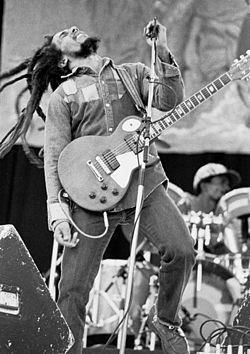
The Wailers, a band started by Bob Marley, Peter Tosh and Bunny Wailer in 1963, is perhaps the most recognized band that made the transition through all three stages of early Jamaican popular music: ska, rocksteady and reggae. Other significant reggae pioneers include Prince Buster, Desmond Dekker and Ken Boothe.
Notable Jamaican producers influential in the development of ska into rocksteady and reggae include: Coxsone Dodd, Lee "Scratch" Perry, Leslie Kong, Duke Reid, Joe Gibbs and King Tubby. Chris Blackwell, who founded Island Records in Jamaica in 1960, relocated to England in 1962, where he continued to promote Jamaican music. He formed a partnership with Lee Gopthal's Trojan Records in 1968, which released reggae in the UK until bought by Saga records in 1974.
Reggae influence bubbled to the top of the U.S. Billboard Hot 100 charts in late 1972. First Three Dog Night hit #1 in September with a cover of the Maytones' version of "Black and White". Then Johnny Nash was at #1 for four weeks in November with "I Can See Clearly Now".
In 1973, the film The Harder They Come starring Jimmy Cliff was released and introduced Jamaican music to cinema audiences outside of Jamaica. Though the film achieved cult status its limited appeal meant that it had a smaller impact than Eric Clapton's 1974 cover of Bob Marley's "I Shot the Sheriff" which made it onto the playlists of mainstream rock and pop radio stations worldwide. Clapton's "I Shot The Sheriff" used modern rock production and recording techniques and faithfully retained most of the original reggae elements; it was a breakthrough pastiche devoid of any parody and played an important part in bringing the music of Bob Marley to a wider rock audience.[2] By the mid-1970s, authentic reggae dub plates and specials were getting some exposure in the UK on John Peel's radio show, who promoted the genre for the rest of his career. Around the same time, British filmmaker Jeremy Marre documented the Jamaican music scene in Roots Rock Reggae, capturing the heyday of roots reggae.
In the second half of the 1970s, the UK punk rock scene was starting to form, and reggae was a notable influence. The DJ Don Letts would play reggae and punk tracks at clubs such as The Roxy. Punk bands such as The Clash. The Ruts. The Members and The Slits played many reggae-influenced songs. Around the same time, reggae music took a new path in the UK; one that was created by the multiracial makeup of England's inner cities and exemplified by groups like Steel Pulse, Aswad and UB40, as well as artists such as Smiley Culture and Carroll Thompson. The Jamaican ghetto themes in the lyrics were replaced with UK inner city themes, and Jamaican patois became intermingled with Cockney slang. In South London around this time, a new subgenre of Lovers Rock, was being created. Unlike the Jamaican music of the same name which was mainly dominated by male artists such as Gregory Isaacs, the South London genre was led by female singers like Thompson and Janet Kay. The UK Lovers Rock had a softer and more commercial sound.
Other reggae artists who enjoyed international appeal in the early 1980s include Third World, Black Uhuru and Sugar Minott. The Grammy Awards introduced the Grammy Award for Best Reggae Album category in 1985.


![[object Object]](https://cdn.jsdelivr.net/emojione/assets/3.1/png/32/1f3a7.png)

.gif)